Give your idea a clear path forward.
Valideate helps founders and product teams turn raw ideas into practical plans for building and launching products. It uses AI-assisted research and real-world testing to explore whether an idea could work, what it would take to make it happen and where to start.
- Planned release
- Q4 2026
- Built for
- Founders & product teams
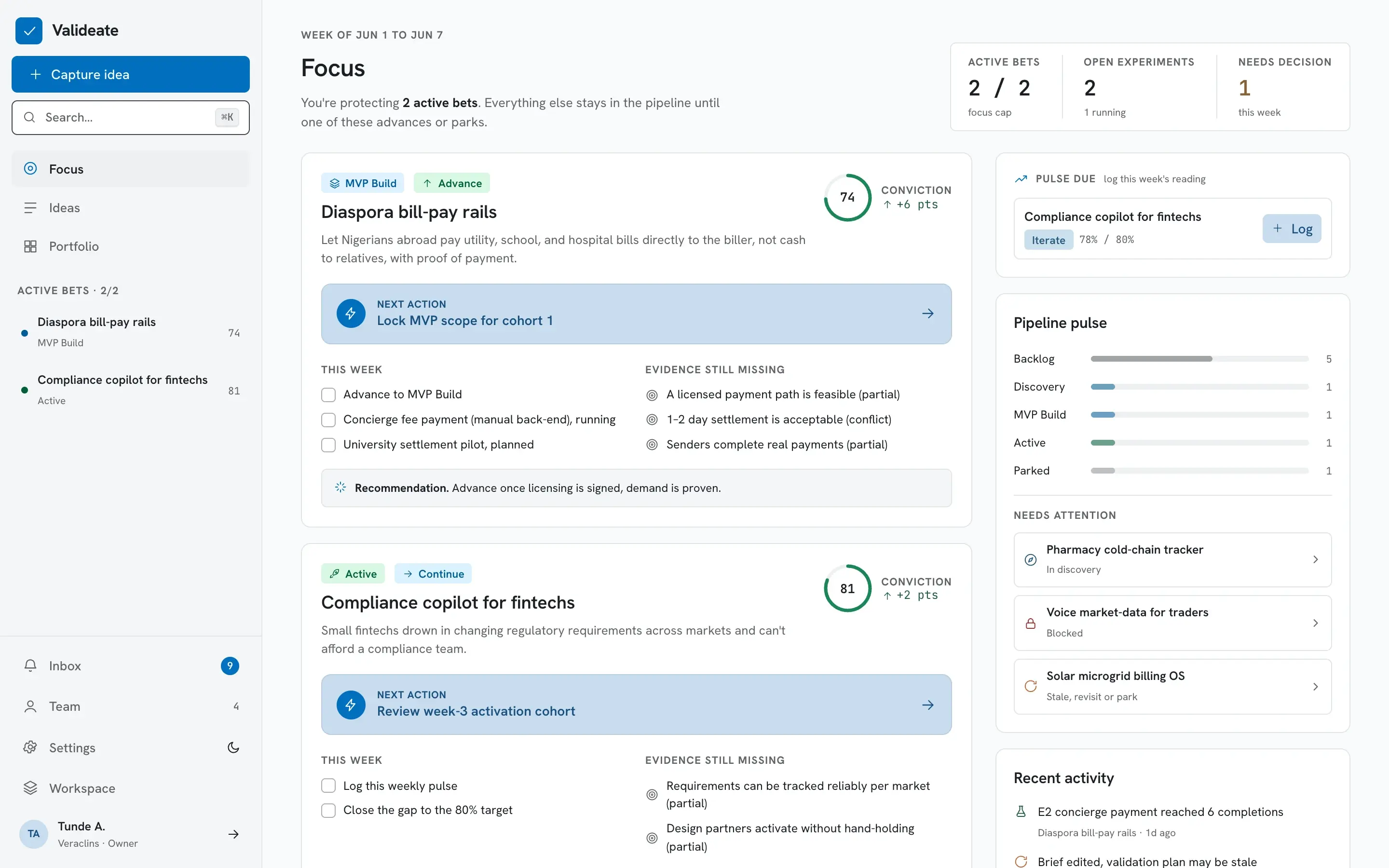
Start with an idea and the questions behind it
Capture an idea in a few words. Guided discovery then works through who it is for, how they manage today, why now and the riskiest assumption, researches each one and suggests the narrowest group to serve first.
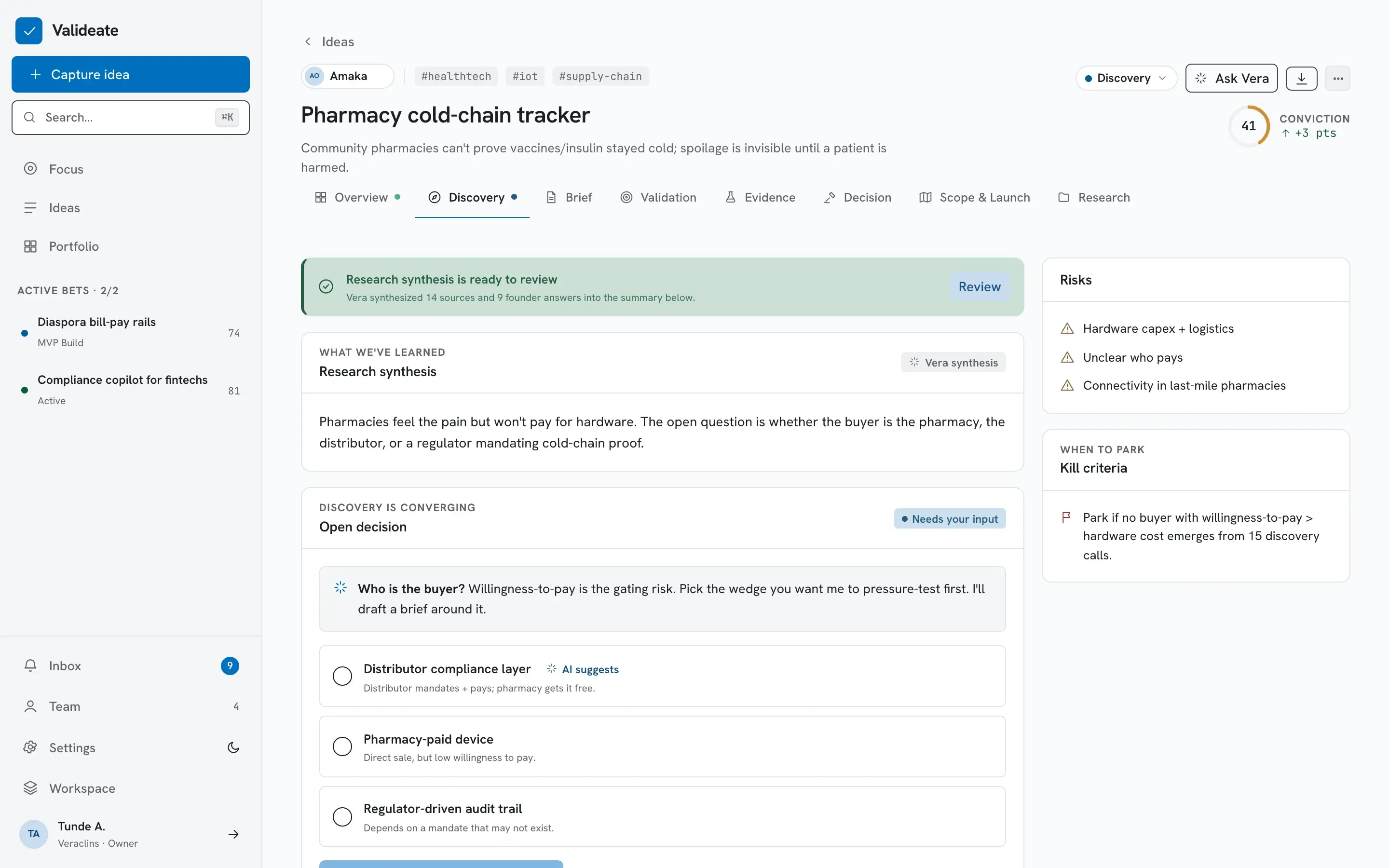
A starting point
Compare possible approaches and pick the one to test first, or reframe the idea and run discovery again.
What would make you stop
Discovery sets out the conditions that would end the idea, before you are attached to it.
What it would take
See the skills, people, partners and permissions the idea needs, what you already have and what is missing.
Test the assumptions that matter
Every idea rests on assumptions, and each one gets its own check with a pass mark set in advance. When research and experiments disagree, Valideate shows both, explains why they differ and lets the stronger evidence lead.
Research you can inspect
Questions research can settle go to AI-assisted research, with every source listed.
Experiments for behaviour
Questions about what people will actually do go to interviews, pilots and other experiments.
Conflicts, not averages
When findings disagree, you see the effect on your confidence and what it changes in the first version.
Decide what to do next
Bring the evidence together to move forward, keep testing, change direction or set the idea aside. The decision records its reasons, the open blockers and how each assumption was tested.
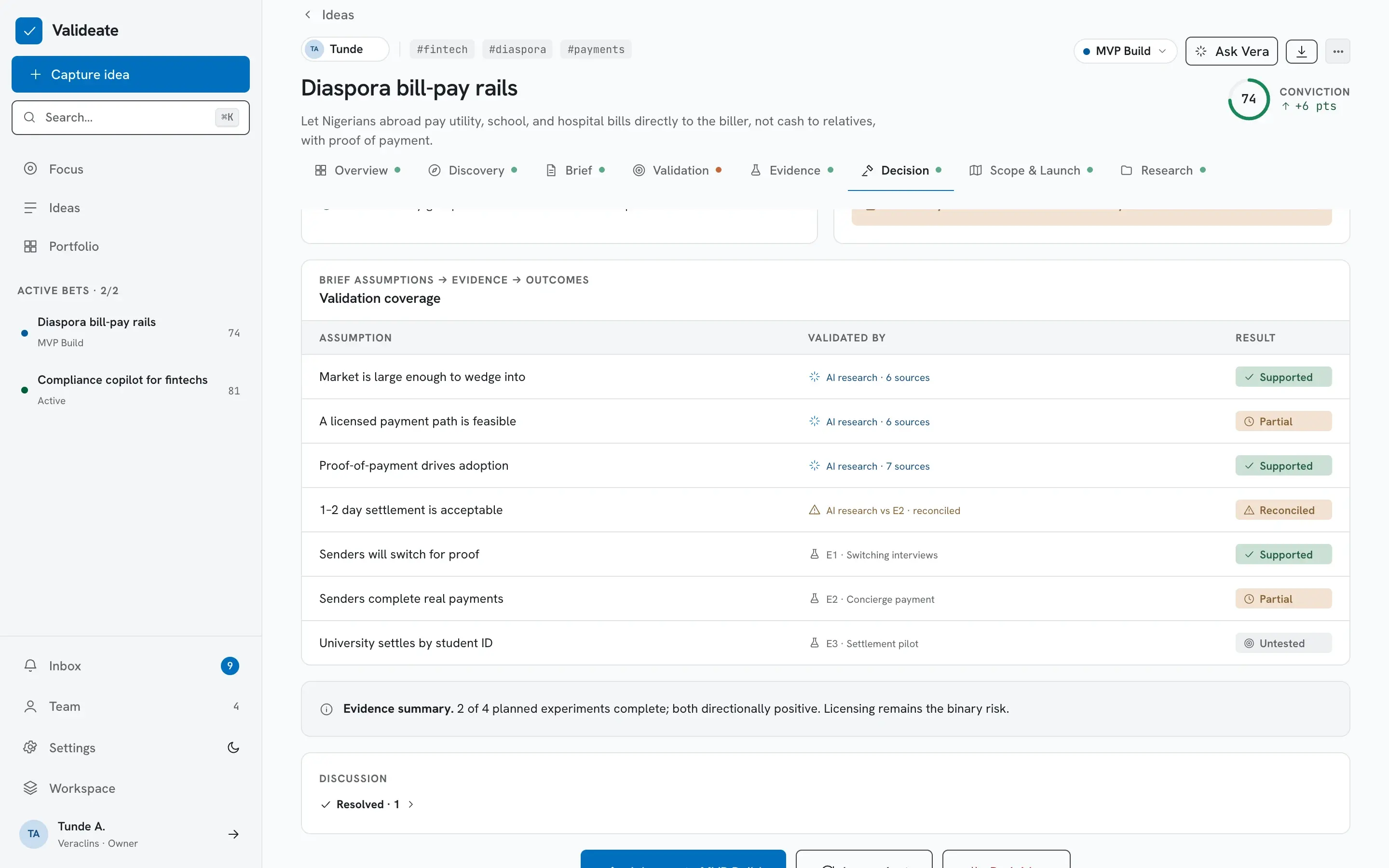
Every assumption accounted for
See which are supported, partly supported, contested or still untested.
Share the reasoning
Send a read-only decision page to anyone who needs to understand why.
Plan the first version
For an idea you pursue, define the one outcome the first version must deliver. Separate what it must include from what can wait, and set a single measure of success and a plan for reaching your first users.
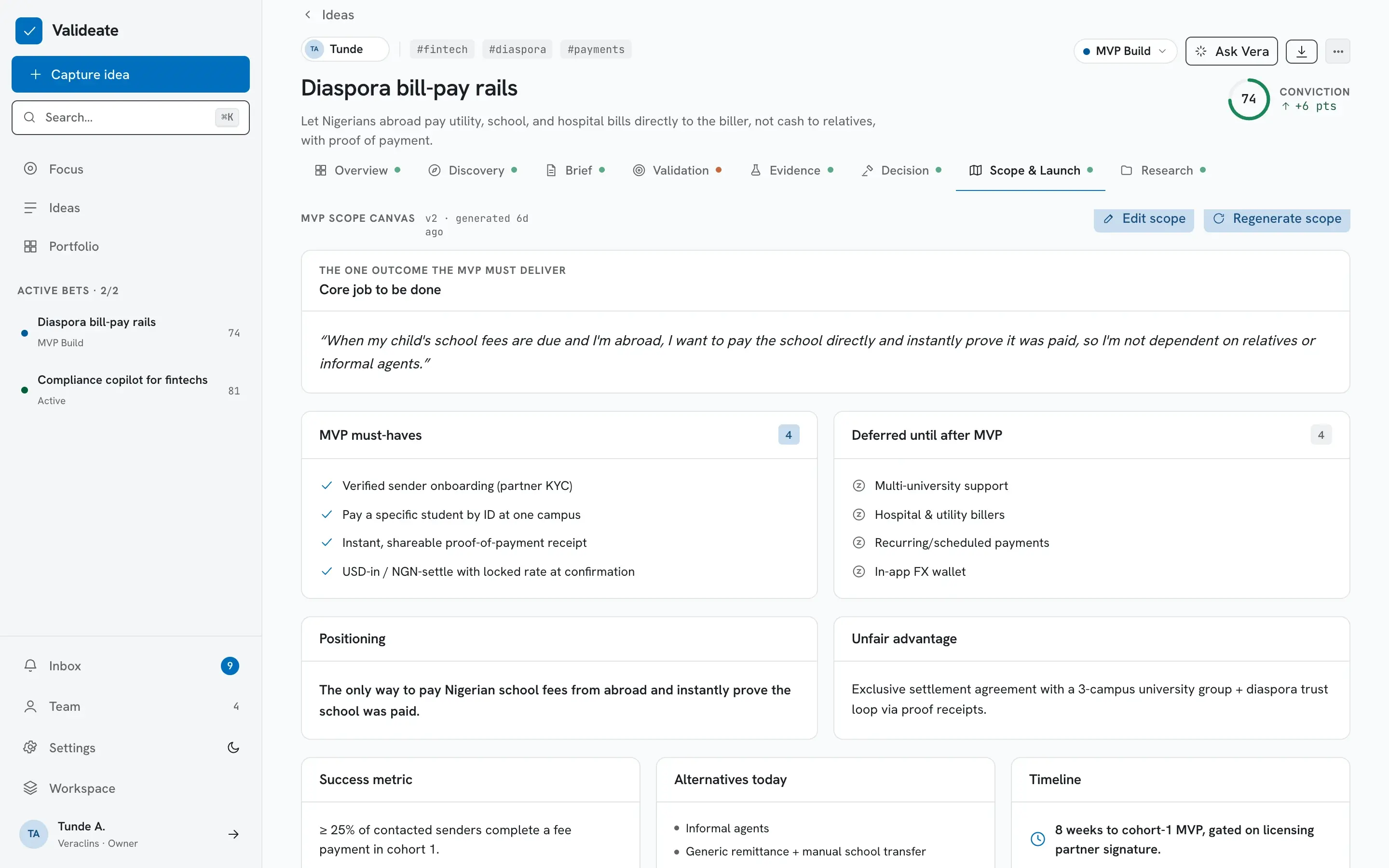
Linked to the evidence
If a decision changes, anything built on it is marked out of date, so plans never drift from what you learned.
A handoff for builders
Tasks with owners, readiness across design, engineering, compliance and launch, and the documents each person needs.
Learning after launch
Regular check-ins turn into a recommendation to grow, keep improving, change direction or stop.
Keep many ideas, pursue a few
Every idea sits in one pipeline, from backlog through discovery and build to launch, with a confidence score, how strong its evidence is and its next action. You can pursue two at a time, and Focus opens on what matters today for those two.
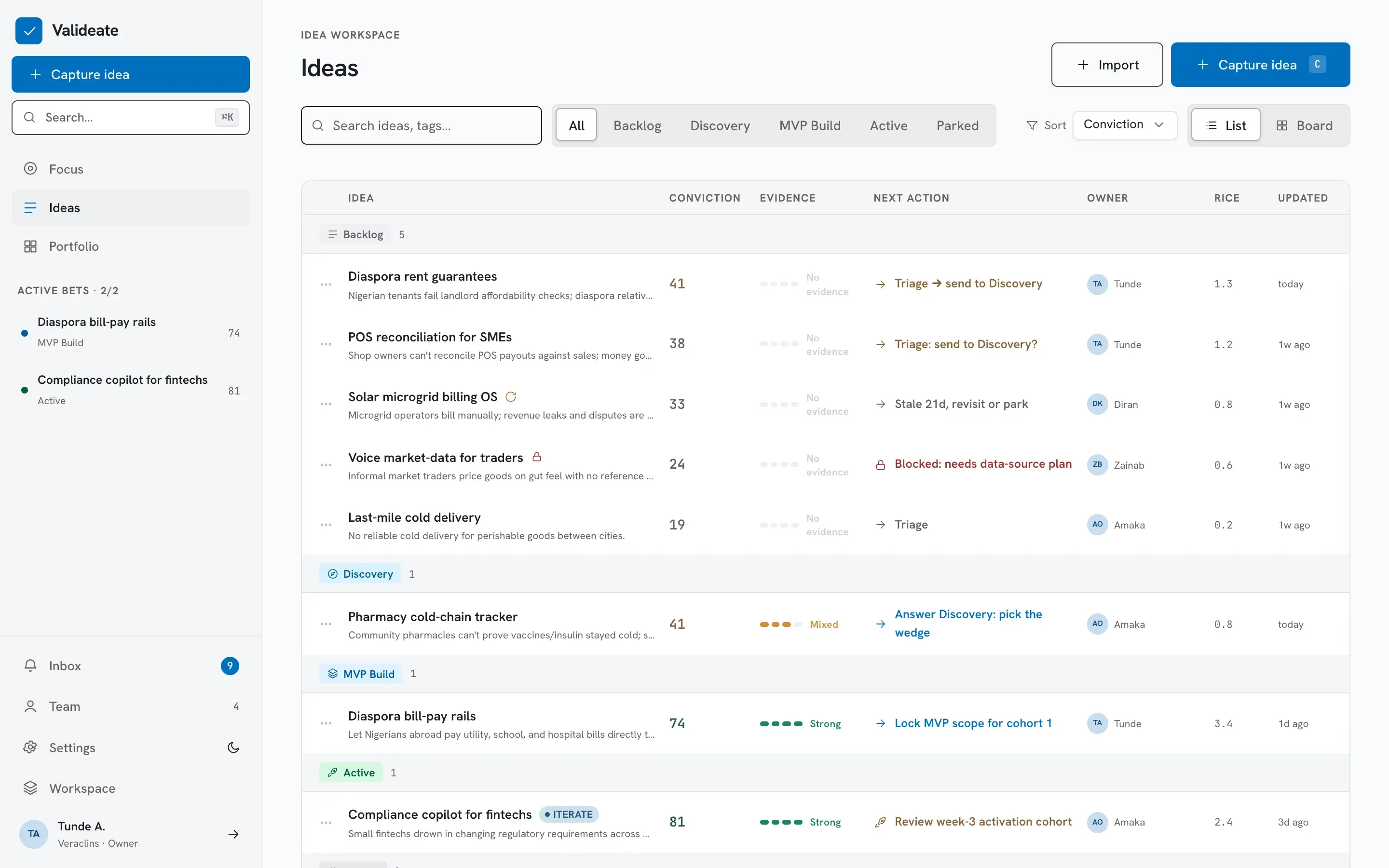
One stage at a time
Ideas move forward one stage at a time and can be parked from anywhere, with their evidence kept.
Work as a team
On team plans, members share the pipeline, with roles for who can edit and who can only view.
Questions about Valideate
Who is it for?
Founders, product teams and venture studios researching ideas, planning what to build and learning from the products they launch.
What does the AI help with?
Researching the idea, organising findings and preparing material for decisions and planning. You can inspect its sources and assumptions and add evidence from your own work.
Does a positive assessment mean the idea will succeed?
No. It helps you assess the evidence and what execution may require. Customer needs, practical testing and the decisions you make still matter. Identifying a possible permission or licence requirement does not confirm that you have met it.
Does Valideate build the software for me?
It helps you prepare the scope, roadmap and handoff. The product itself still needs to be designed, built and operated.
When is release planned?
Q4 2026. Join the waitlist for product updates, opportunities to help us test it, and launch news.
Take your idea further
Join the Valideate waitlist for product updates, opportunities to help us test it, and launch news.